
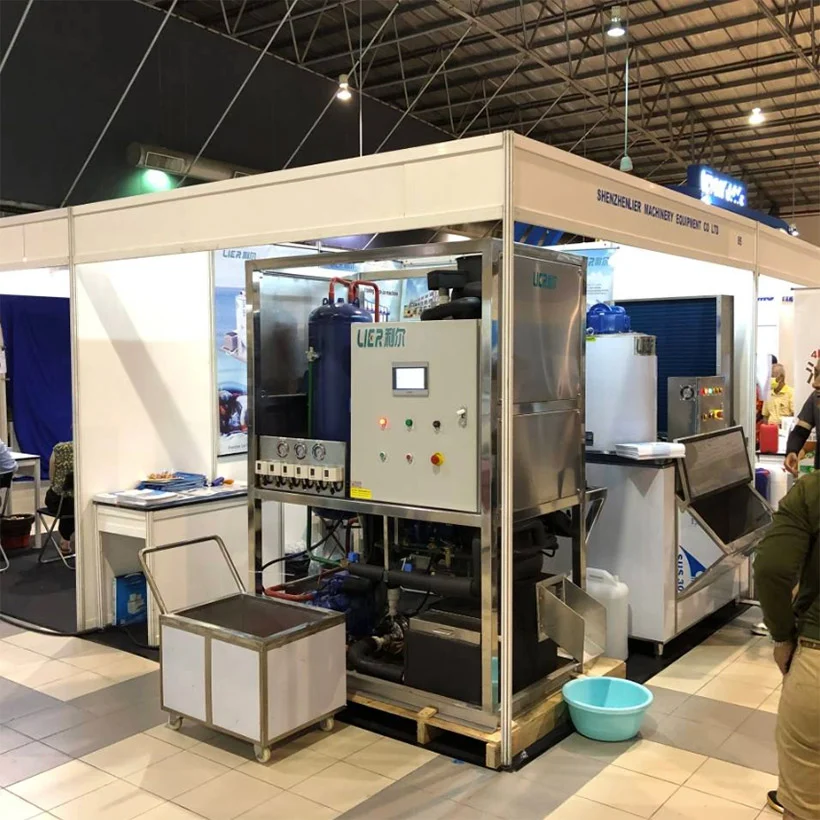
How Do Industrial Ice Machines Work? A Simple Guide to the Basic Refrigeration Cycle
Industrial ice machines may look very different from one another, but the basic principle behind most refrigeration-based systems is relatively simple: heat is removed from water or another medium until the desired ice is formed.
Understanding this basic process makes it much easier to understand different types of ice machines, their main components, and the factors that affect their performance.
1. The Basic Idea: Making Ice by Removing Heat
An ice machine does not simply “make cold.” Its main job is to remove heat.
Water enters the ice-making system at a certain temperature. The refrigeration system absorbs heat from the water through the evaporator. As the water loses enough heat, it freezes and forms ice.
The basic process can be simplified as:
Water → Heat Removal → Freezing → Ice
The refrigeration system then carries the removed heat away from the ice-making area and releases it through the condenser.
This continuous heat-transfer process allows an industrial ice machine to produce ice repeatedly.
2. The Four Main Components
Although the design varies between machines, a conventional refrigeration system normally includes four key components:
Compressor
The compressor is the driving component of the refrigeration cycle.
It compresses the refrigerant gas and increases its pressure and temperature. The refrigerant then moves toward the condenser.
Condenser
The condenser releases heat from the refrigerant.
After giving up its heat to the surrounding air or cooling water, the refrigerant changes into a high-pressure liquid and continues through the refrigeration circuit.
Expansion Device
The expansion device reduces the pressure of the liquid refrigerant.
As the pressure drops, the refrigerant becomes much colder and enters the evaporator in a condition suitable for absorbing heat.
Evaporator
The evaporator is where the refrigeration system absorbs heat from the ice-making process.
Depending on the machine design, water may flow over, around, or against a cold evaporating surface. Heat is transferred from the water to the refrigerant, allowing the water to gradually freeze.
For many industrial ice machines, the evaporator is therefore one of the most important components determining the final ice form and production characteristics.
3. How the Refrigeration Cycle Works
The four main components work together as a continuous cycle:
Compressor → Condenser → Expansion Device → Evaporator → Compressor
At the evaporator, the refrigerant absorbs heat.
At the condenser, that heat is released.
The compressor provides the pressure difference needed to keep the refrigerant moving through the system.
This cycle continues while the machine is producing ice.
4. Why Different Machines Produce Different Types of Ice
The refrigeration principle may be similar, but the ice produced can be very different.
The design of the evaporator, water distribution system, freezing surface, operating conditions and ice-harvesting method all influence the final product.
For example:
-
Cube ice is typically formed in individual molds or cells.
-
Flake ice is formed as a thin layer of ice on a refrigerated cylindrical surface and then removed into flakes.
-
Tube ice is formed around the outside of refrigerated tubes.
-
Block ice is generally produced by freezing larger volumes of water in molds.
The result is ice with different shapes, thicknesses, melting characteristics and applications.
This is why choosing an industrial ice machine is not simply a question of production capacity. The required ice type and application are equally important.
5. What Affects Ice Machine Performance?
Actual ice production can vary significantly depending on operating conditions.
Some important factors include:
Ambient temperature
Higher surrounding temperatures generally increase the workload on the refrigeration system.
Water temperature
Warmer inlet water requires more heat to be removed before freezing.
Cooling method
Air-cooled and water-cooled systems transfer heat in different ways and may perform differently under specific site conditions.
Refrigeration system configuration
The compressor, condenser, expansion device, evaporator and control system must work together as a suitable system.
Ice thickness and harvesting method
Different ice products require different freezing and harvesting processes, which affect the machine’s operating cycle.
For this reason, the same nominal-capacity machine may not produce exactly the same amount of ice under every working condition.
6. Capacity Is More Than a Number
When comparing ice machines, production capacity is often one of the first specifications buyers look at.
However, a capacity figure should always be considered together with its operating conditions.
For example, a machine rated at a certain number of tons per day is normally tested or specified under particular conditions, such as ambient temperature and water temperature.
When evaluating a machine for an actual project, it is therefore useful to consider:
-
Required ice type
-
Daily ice demand
-
Ambient temperature
-
Water temperature and quality
-
Available cooling water, if required
-
Installation space
-
Power supply
-
Operating schedule
-
Ice storage and handling requirements
These factors help determine whether a particular machine is suitable for the actual application.
7. A Simple Way to Understand an Industrial Ice Machine
If you are new to industrial ice-making equipment, you can think of the machine as three connected systems:
The refrigeration system
Removes heat.
The ice-making system
Transfers heat from water and forms the required ice.
The control and mechanical system
Controls the operating cycle and supports functions such as water supply, ice harvesting and machine protection.
When these systems work together correctly, the machine can continuously produce ice under the intended operating conditions.
Final Thoughts
Understanding the basic refrigeration cycle is a useful starting point for anyone involved in industrial ice-making equipment.
The principle is straightforward: the refrigeration system removes heat, the water freezes, and the resulting ice is harvested for use.
What becomes more complex is how the system is designed for a specific ice type, production capacity and working environment.
That is why industrial ice machines should be evaluated not only by their advertised capacity, but also by the ice required, application, operating conditions and overall system configuration.
In future articles, we will look more closely at different ice types, machine components, applications and practical considerations when selecting an industrial ice-making system.